The European Commission (EC) has formalised the adoption of the EU-US Privacy Shield, a new framework for transatlantic data transfers, placing greater obligations on US companies to protect European’s personal information.
The Privacy Shield replaces Safe Harbour, a similar agreement that was invalidated in October 2015 following a customer’s lawsuit against online social networking service Facebook. The complaint hinged on leaked documents by Edward Snowden, a former contractor of the US National Security Agency (NSA)—an incident that hinted at sharing of European’s private information with US intelligence agencies.
For Europeans, the new framework means greater transparency on transfer of personal information to the US and stronger protection of personal data. It also provides for an easier and cheaper redress possibilities in case of complaints.
As for American companies, it requires them to do annual self-certification that they abide by the requirements. They also have to display privacy policy on their websites, reply promptly to complaints, and cooperate and comply with European Data Protection Authorities.
Under the new framework, the US Commerce Department will have regular updates and reviews of companies to ensure compliance. Those found not following the rules will face sanctions and be removed from the list.
The Privacy Shield also gives assurance that access to information by public authorities is subject to limitations, safeguards and oversight mechanisms.
The new arrangement promotes effective protection of individual rights, providing citizens with various accessible and affordable resolution mechanisms. An annual joint review mechanism will also overseer how the Privacy Shield performs.
“We have now approved the new EU-US Privacy Shield which will protect the personal data of our people and provide clarity for businesses” said Andrus Ansip, vice-president for the Digital Single Market at the EC, in a news release.
“We’ve worked hard with all our partners in Europe and in the US to make sure this deal is right and to have it signed and sealed as soon as possible. Data flows between our two continents are essential to our society and economy, and we now have a robust framework in place ensuring these transfers occur in the best and safest conditions.”
Technology giants have been awaiting the adoption of the Privacy Shield as compliance enables them to gather and transfer European’s information without violating European’s data protection and privacy laws.
During the talks that ultimately led to the adoption of the new framework, many technology firms including Apple, Google and Microsoft said they lauded the new framework and were preparing to achieve compliance.
It, however, remains to be seen if the EU-US Privacy Shield will pass in the European Court of Justice. Privacy rights organisations have already expressed opposition against the new deal, saying its measures to safeguard European’s information from US intelligence agencies are not sufficient.
The Pokemon Go craze is demonstrating how digital entertainment can create risks in the real world. At least three accidents have been blamed on the app-based game based on the corny collectors’ cards popular in the 1990s.
Pokemon Go creates risks because it is an “augmented-reality” game which directs players to specific real-world locations using a phone’s GPS. At the locations the players are supposed to catch Pokemon characters. The risk is created when players get distracted by the game and stop paying attention to their surroundings.
A 15-year old girl in the American state of Pennsylvania was hit by a car on 13 July; after the game directed her to cross a busy highway, the Associated Press reported. The girl was taken to hospital with an injured collarbone and foot after being hit by a vehicle.
Two men fell off a seaside cliff near San Diego, California; while playing Pokemon Go on 13 July. Fire-fighters had to rescue the men after one fell 80 to 90 feet; and another fell 50 feet (15 meters), to the beach below. Both men were taken to hospital with unspecified injuries.
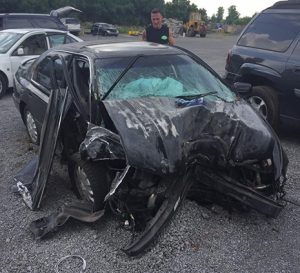
Damaged car after player drove it into a tree whilst trying to catch a Pokemon sea creature
Upstate New York resident Steven Cary suffered a broken leg and lacerations after driving his car into a tree, The Smoking Gunreported. Cary admitted that he was trying to catch the Lapras Pokemon and driving when he hit the tree. The car was completely destroyed in the accident photographs indicate.
A different kind of risk was reported in San Luis Obispo, California; where Pokemon Go directed players to a halfway house for convicted sex offenders according to The San Diego Union Tribune. The newspaper speculated that the Sunny Acres halfway house may have been included in an older app that was incorporated into the game.
There is also a risk of robbery; three Pokemon Go players were held up by an unidentified gunman in College Park, Maryland, near Washington DC, The Baltimore Sunreported. The college students encountered the robber when Pokemon Go directed them to a local landmark.
Death by Pokemon
News coverage indicates that Pokemon Go is encouraging risky behaviour around the world. Police in Cambridgeshire, UK issued warnings after police officers were called over because of players were climbing roofs and trespassing on private property.
Some observers fear that Pokemon Go will lead to a fatality. If the deadly accident occurs in the United States it will undoubtedly lead to a wrongful death lawsuit.
“Death by Pokemon is coming” Gerry Beyer, a law professor at Texas Tech University told Fox News. “Pokemon users will have all sorts of accidents as they use the program while walking, biking, driving, etc.”
In addition to accidents there is a risk of fatal shootings. Beyer noted that under the law in some American states; including Texas and Colorado, it would be legal for a property owner to shoot a trespassing Pokemon Go player. Those jurisdictions have the so-called “Make My Day Law” which allows residents to use deadly force to protect their homes, on the books.
Another risk players would face is being shot by guards at high-security installations. Three teenagers were detained at the Perry Nuclear Power Plant in Ohio after Pokemon Go directed them to the facility on 12 July, Fox News reported.
Who is liable for Pokemon Go damages
The obvious question that Pokemon Go raises for insurers is liability. Who would be liable for injuries, deaths or damage related to the game?
Are the players responsible for their actions, or do the game’s owners and creators have some responsibility for enthusiasts’ behaviour? An argument can be made that Pokemon Go is manipulating impressionable and immature individuals including teenagers.
Personal injury attorneys in the United States will undoubtedly argue that Pokemon Go’s owners and are responsible for damages because of their deep pockets. Pokemon itself is the property of The Pokemon Company; a Japanese consortium that includes video game maker Nintendo
Nintendo has certainly been profiting from Pokemon Go, its market capitalization more than doubled in the week after the app was released, The International Business Timesreported. The value of Nintendo’s stock increased from £9.1 billion ($12 billion) to £22.74 billion ($30 billion).
Are game developers liable for damages
Also liable is Niantic Inc., the San Francisco start up that developed the game itself. Niantic is receiving around 30% of the profits from Pokemon Go sales through the App Store and Google Play, Macquarie Capital Securities Analyst David Gibson estimated. Apple Inc.; which owns the App Store, and Alphabet Inc. – which owns Google Play – are also receiving a hefty cut of the Pokemon Go royalties, Gibson speculated.
That means all of those companies will be targets for Pokemon Go related lawsuits. It also indicates that they and other app game developers might be require some sort of specialized insurance coverage. Another potential product is some sort of liability insurance for game players, which might even be sold with the app.
Niantic itself has admitted it has some liability; by including recommendations that players must be aware of the surroundings, and not enter private property without permission in the game. Niantic has also claimed it is not responsible for property damage, a determination that can only be made by the courts.
The liability question in the United States is complicated by homeowners and renters insurance. Some of those policies cover damage to other people’s property, the Insurance Information Institute noted. That creates the potential for litigation involving insurers, players or their parents, the game’s owners and developers and property owners. Some insurers are sure to argue that Niantic, Nintendo; and possibly Google or Apple, are liable for damages caused by players.
Lawsuits arising from Pokemon Go may lead to important precedents because augmented-reality app games are becoming big business. Between 6 July and 12 July, Pokemon had attracted 21 million users in the United States alone, SurveyMonkey reported.
Pokemon Go demonstrates how digital products can create real world risks and increase liabilities. Insurers will have to take account of those risks and create new kinds of coverage to deal with them.
In the first round of a class action lawsuit, which has garnered a lot of international publicity, silicosis claimants had their class action lawsuit approved. This move could potentially cost the gold mining industry upwards of $3.25 billion USD.
Back in May 2016, the High Court in Johannesburg South Africa, awarded the certification judgment which has provided the opportunity for approximately half a million miners to claim compensation from former employers.
A miners attorney speaking to journalists outside the South Gauteng High Court in Johannesburg
In the last 10 years, lawyers in the United States, United Kingdom and South Africa have been making alliances in the effort to pursue compensation for the affected miners and their families. Initially, prosecution of damages in the UK was hampered by the English Court of Appeal, who refused to exercise jurisdiction over a mining company domiciled in the UK. That case was Young v Anglo American South Africa Ltd and Others, 2014. It is worth noting that damages are generally more generous in the UK than in South Africa.
In South Africa, back in 2006, an initial action by Mr Makayi for damages against his former employer, AngloGold Ashanti, was started. It alleged that their negligence resulted in him contracting silicosis.
The disease is only contracted through exposure to silica dust, a byproduct of mining for gold. It is alleged that the risk of contracting tuberculosis is increased by inhaling the dust, resulting in the disease.
The company challenged the action and claimed that Mr Makayi had been compensated through statutory framework under the Occupational Diseases in Mines and Works Act of 1973.
However, the Constitutional Court in South Africa decided that the statutory framework was separate from a compensation framework created by the overarching legislation. As a result, the claim was approved to proceed. As a result, this opened up the courts to three separate groups of litigants who sought certification for a class action suit against their own mining employers
In 2012, those three applications were consolidated – in 2015 they were argued, giving rise to the May 2016 certification judgment. The consolidated case is Nkala and Others v. Harmony Gold Mining Company Ltd and Others, 2016.
Initially, the court determined that notwithstanding, prosecution based on an alleged breach of a fundamental right in the South African Constitution meant certification by the court was necessary. It made the decision based on limited local jurisprudence because class action lawsuits are relatively new in South Africa. Failing to certify could potentially lead to an abuse in process.
Next, the court looked at whether the applicants met the requirements for certification, namely:
Whether the class was defined with the appropriate precision
If there were common issues of fact or law capable of class action determination
Whether allowing for a class action suit was appropriate in the circumstances
Despite the overbroad definition of the classes, including miners who had silicosis or tuberculosis or their descendants, or the fact that the period covered was lengthy, including all those affected after 1965, the court decided that the proposed class was capable of objective determination.
It was also considered whether there were enough common, factual issues that could be dealt with; regarding claims against mine operators, the court pointed out that applicants should provide evidence of the following:
Mining companies working to deprive miners of basic health and safety rights
A relationship between silica dust exposure and silicosis
Reports by different commissions showing lack of compliance with statutory rights
That since 1990, mining companies were aware silicosis was preventable through safer mining practices
That the results of investigations demonstrated exposure to silica dust and flouting internationally-accepted best practices
The court also decided that given the amount of technical evidence, individual miners would struggle to prosecute their actions separately. As the evidence applied generally to each of their cases, multiple claims would only be a burden on the court system and swamp them with repeat evidence. As such, a class action suit was deemed to be more appropriate.
Next, the court ruled that parent companies that advised and guided operating companies should also form part of the class action lawsuit because they could answer factual issues the claimants presented.
The information presented satisfied the court that the matters of law could be dealt with most effectively in this way, including:
Whether any breaches of health and safety legislation could increase the imposition of strict liability
If both joint and several liability could be imposed on multiple mining companies if they had employed the same miners
Whether causation could be of the legal principle could be determined, shifting the burden of proof to prove miners who contracted silicosis or tuberculosis did so at the hands of their former employers
Ultimately, the court decided a class action lawsuit was the most realistic way to provide access to the courts to pursue this matter. While this decision was expected, the more noteworthy decision was that damages for pain and suffering could be transferred to miners’ estates even after pleadings were closed.
On the other hand, the miners argued that the rule of common law infringed on provisions to protect them under the South African Bill of Rights. These included the right to equality. The court also took into consideration the other jurisdictions such as the UK and ruled it would be a huge injustice if common law wasn’t appropriately applied.
Most recently, on 6th July the mining companies filed the intention to appeal. The case will now proceed through the court system; if and when it’s heard, it will certainly result in more upheaval of the gold mining industry. It should also impact how South African jurisprudence is developed.
What this case really shows is that between the claimants and the international jurisprudence, it has truly become far more than just a South African issue. This is truly an interesting matter that will continue to garner attention worldwide; many mining companies and investors will be closely monitoring the outcome.
GE Capital, the financial services arm of American multinational conglomerate General Electric, recently welcomed good news following its removal from the Financial Stability Oversight Council (FSOC)’s list of ‘Too-Big-To-Fail’ capital providers.
This marks the first time that the FSOC — the US government’s watchdog that identifies and monitors excessive risks to the country’s financial system — has lifted Systematically Important Financial Institution (SIFI) designation off a non-bank financial company.
A company that gets the SIFI designation becomes subjected to stricter regulatory scrutiny, tightened capital planning and stress-testing requirements.
The council gave the designation in July 2013 due to several issues such as GE Capital’s leading position in various funding markets and dependence on short-term wholesale funding.
FSOC determined that its failure could threaten the financial stability of the country and thus be subjected to the supervision of the Federal Reserve and tightened prudential standards.
During the time of designation, GE Capital was one of the country’s biggest financial services companies based on assets and an important credit source.
The company has worked with regulators for over a year and made drastic strategic changes to lift the council’s designation.
It has divested about $272 billion (£200 billion) of bank and nonbank assets and transformed its funding model, significantly reducing the use of and dependence on short-term funding.
GE Capital also went through a corporate reorganisation. It is now mainly comprised of three business lines: GE Capital Aviation Services, Energy Financial Services and Industrial Finance.
It also reorganized its legal entity structure by merging GE Capital into GE and transferring all its businesses and assets to a new intermediate holding company called GE Capital.
The firm has decreased its total assets by more than 50 percent and also reduced its interconnectedness with huge financial institutions.
On June 28, 2016, FSOC finally repealed the designation following a thorough review and engagement with GE Capital in the past year.
“The Council’s rescission of GE Capital’s designation is the result of a methodical analysis of risks that is in keeping with the law and the lessons of the financial crisis” said Treasury Secretary Jacob J. Lew in a press release.
“The Council designated GE Capital in 2013 after identifying a number of key concerns, including the company’s reliance on short-term wholesale funding and its leading position in a number of funding markets. Since then, GE Capital has made fundamental strategic changes that have resulted in a company that is significantly smaller and safer, with more stable funding. After a rigorous review and engagement with the company over the last year, the Council determined that based on these changes, the designation is no longer warranted.”
Since its founding in 2010, FSOC has named four nonbank financial companies that could pose a threat to the country’s financial stability. These include property/casualty insurance company American International Group (AIG) and life insurers MetLife and Prudential Financial. MetLife successfully challenged the designation in the federal court, with the federal government now appealing the decision of the District Court.
Lloyd’s (re)insurer Sompo Canopius has just announced strategic partnership with Mexican insurer, Grupo Nacional Provincial (GNP). The companies released a joint statement on the 28th June that detailed the arrangement, which will allow both parties to develop new business and insurance products for the Mexican market.
The collaboration will leverage GNP’s position as a leading domestic insurer in Mexico and taking Sompo Canopius’ specialist underwriting expertise to the market.
The strategic partnership will also enable GNP to widen its portfolio as one of the top underwriters to include international risks through access to Sompo Canopius’ multiline Lloyd’s of London Syndicate 4444.
Stuart Davies, CEO of London-based Sompo Canopius, said “We are looking forward to working with GNP as we develop our strategic partnership. The combination of our underwriting skills and specialist expertise, and GNP’s understanding of the local market and established distribution, will allow us together to develop new business and broaden our knowledge base”
GNP CEO Mario Vela enthusiastically described the new partnership with Sompo Canopius as an exciting development for the Group. “Our partnership with Sompo Canopius will provide us with an increased international exposure through their position at Lloyd’s and enable us to expand our product range to meet the growing local demand for specialist insurance products”.
Guy Carpenter acted as adviser to GNP on the partnership formation.
Giant Swedish box retailer IKEA is voluntarily recalling over 35 million dressers in North America after six children in Canada and the United States died from tipping and entrapment accidents linked to the furniture.
The chests of drawers did not meet US safety standards although they did meet European and Chinese safety standards. Even so, China has complained that they are being excluded from the recall program.
IKEA’s reputation is suffering from the publicity of 6 child deaths and their decision to not recall the same furniture in Europe and China because it meets safety standards in those regions. Such product accidents and recalls are only one example of how bad press can taint or destroy a brand’s reputation.
Often it does not matter what steps a company takes to address such issues such as a recall, the memory of such incidents can forever tarnish consumer trust in a brand.
Why is a brand’s reputation important
A strong brand reputation provides greater profits. A reputational value incorporates four basic consumer elements: perceptions, expectations, unique intellectual property assets and business relationships.
We live in a time where relationships have never been stronger or more important in terms of how consumers base their buying decisions. That is why so many executives put so much effort into protecting their brand reputation.
According to one survey, over three fifths of chief executives said they believed corporate brand and reputation represented more than 40% of their company’s market capitalization. Yet it is a very difficult thing to protect against.
The actions of a single employee can destroy a brand reputation, a poor executive decision can affect a brand’s reputation, a faulty product, poor customer service or a dissatisfied customer can all be responsible for tarnishing a brand’s reputation.
Japanese auto brands were all subject to reputation risks and damage when Honda had to recall faulty airbags. Often, reputation risks are not limited to a company itself. Damaged reputations can occur through association. In the Honda case because the automaker is Japanese, all of the other Japanese automakers were associated with Honda by consumers.
If one brand experiences a fault such as the airbag issue, consumers start worrying that all Japanese automakers are experiencing the same problem or share the same safety or quality faults. This makes trust dip and consequently sales.
Protecting a brand’s reputation is a key driver in today’s environment compelling companies to follow strict hiring, manufacturing and safety protocols as well as thoroughly vetting and dealing with respectable vendors. They do their best to ensure a high level of customer service, safety and satisfaction yet sometimes things go wrong.
How can a brand protect its reputation
There is no easy answer to this question. Going back to the example of IKEA the furniture problem was discovered after it was sold, and even though it comes with a kit to secure the furniture to a wall to prevent tipping accidents it is impossible for the company to ensure that every consumer will properly install the anchors or even use them.
Because it is difficult to protect a brand’s reputation it is very important for companies to have a good crisis management plan and recovery execution strategy in place. Another important step companies are taking is long-term financial reporting of reputational risks to help executives make smarter project and business choices that limit or reduce the exposure of reputational risks occurring.
Several insurance companies now offer reputational risk products designed to prevent, protect or mitigate attacks on a brand’s reputation from all types of events such as social media negative campaigns, recalls, accidents such as oil rig explosions and product contamination.
Zurich Insurance, the first insurer to develop a stand-alone Crisis Management policy according to a report published by the Chartered Insurance Institute (CII), provides covers that respond to reputation damaging events. However, it seems the product is reserved to only very large customers as Zurich does not actively market it.
Other companies such as Tokio Marine Kiln and Liberty, according to the CII report, provide the most advanced products in response to brand and reputational damage as both products are relatively new and provide cover for Loss of Revenue in addition to Crisis Management costs.
Reputation management has become a big business in itself with ever greater attention being given over to finding new ways of protecting a company’s most valuable asset-their reputation.
Sometimes, despite the best efforts of a company, their brand reputation cannot be repaired or saved. Findus, is a case in point. The company, based in Grimsby, England, was famous for its line of frozen food products.
Findus – Beef Lasagne contained Horse meat
In 2013 Findus was caught in a big horsemeat scandal when tests revealed that their beef lasagna products actually contained up to 100% horsemeat. This scandal left the company in shreds and it has not been able to overcome the damage to its reputation.
Now, the Findus brand is disappearing from the shelves and the products they produce will be launched and marketed under new names.
Assigning liability might be the greatest problem that the advent of self-driving vehicles poses to insurers. The first confirmed death of a motorist in an autonomous car indicates that nobody knows who is liable in such cases.
Joshua Brown was using the “autopilot” feature when his Tesla Model S collided with a semi-tractor in Florida on 7 May, news reports indicate. The car failed to stop when the truck pulled in front of it, the Florida Highway Patrol reported. Brown, a known Tesla enthusiast was killed in the accident.
The Model S was knocked clear of the highway and landed in a nearby field. One of the first men to reach the wrecked vehicle claims a Harry Potter movie was playing on a DVD player in the car, Reuters reported. Another witness told Reuters that he heard no movie playing when he reached the crash scene.
A highway patrol officer did find a DVD player with a Harry Potter video on it in the wrecked car, Reuters reported. The possibility that Brown was watching a movie instead of the road reinforces charges that autonomous vehicles encourage reckless behaviour on the part of motorists.
What is Tesla’s liability
The obvious liability issue for Tesla is whether the autopilot failed to detect the semi-tractor and the trailer it was pulling. The autopilot system is supposed to detect vehicles and other objects and brake or steer around them as you can see in one of the video posted by Mr Brown early April of this year before his death.
Witnesses said the Model S did not stop but kept going straight into the trailer. An unidentified Tesla spokesman admitted that the sensors in the vehicle might not be able to distinguish white vehicles like the truck involved in the accident from sunlight.
An even greater issue is who was ultimately at fault; Brown for behaving irresponsibly, or Tesla for encouraging his behaviour with claims about its autopilot features. Brown’s family obviously has a case against Tesla and its CEO Elon Musk; who has bragged about the autopilot’s capabilities in the past.
The case can certainly be made that Tesla assumed liability for Brown’s actions; by designing a feature that performs some of the driver’s functions. The liability is enhanced by Tesla’s claims that the autopilot is capable of steering the vehicle under certain conditions.
The limited evidence available from news articles indicates that Tesla has inadvertently assumed liability for the damage done in the accident. That will have to be determined by American courts – a process that will take years.
Tesla has taken some steps to limit the liability created by self-driving features. Last year The Wall Street Journalreported that the Model S contains a feature that allows it to automatically pass other cars. This feature is apparently activated by hitting the turn signal.
The thinking is that by pressing the turn signal button the driver assumes liability for the vehicle’s actions. The impetus is put on the driver to assume that conditions are safe enough to let the car operate autonomously.
What is the driver’s liability
That ploy might not help Tesla in the Brown case because the vehicle was travelling straight and not passing. The liability issue is cloudy; because Brown had the ability to take control of the car at any time, but he failed to do so.
Such liability is an important issue in the United States because it may determine who will pay any claims arising from accidents. Is Tesla at fault, or was Mr. Brown and now possibly his heirs.
If Tesla is found at fault, it could create a precedent for American auto insurance companies to refuse to pay claims in cases involving autonomous vehicles. A related issue is whether Mr Brown, or his heirs, assumed liability for the inherent risks when he activated the autopilot.
Tesla; or an insurer, might argue that Brown created unnecessary risks by abusing the autopilot system. That of course raises the questions of whether there was a legal contract requiring Brown to behave in a certain way while using autopilot. A related question is did Brown break such a contract by watching the movie instead of the road?
The existence of such a legal relationship or contract; would necessitate the existence of a policy designed to cover those circumstances. If no such policy exists, the question has to be raised did Tesla violate mandatory insurance laws by putting a vehicle with autopilot of on the road?
An even more troubling question is was Brown driving without insurance when he was using autopilot. If no existing policy covered his special circumstances, it can be argued that Brown was violating Florida law which requires insurance for all motorists; even if he had paid for standard auto coverage. It might also be argued that Tesla violated the law by making the autopilot available, without providing insurance coverage for it.
New insurance products will be needed
There is one clear lesson that insurers can learn from the Brown tragedy. New insurance products will have to be designed to cover autonomous cars, because present liability standards are inadequate.
A new kind of policy that covers the both the driver and the manufacturer might be necessary for self-driving vehicles. That raises many other questions; including who will cover the costs of such a policy?
The Brown case demonstrates that insurers may have to go back to the drawing board and create an entirely new class of policies for autonomous vehicles. Such products might be necessary, because traditional notions of liability may not apply to claims arising from accidents involving self-driving vehicles.
The risks associated with bitcoin are increasing rapidly, because the market for the popular cryptocurrency has exploded in recent months. Growing market instability; and increased popular doubt about the viability of currencies like the Euro, the Chinese Yuan and even the Pound Sterling, heave greatly increased the value and risks associated with bitcoin.
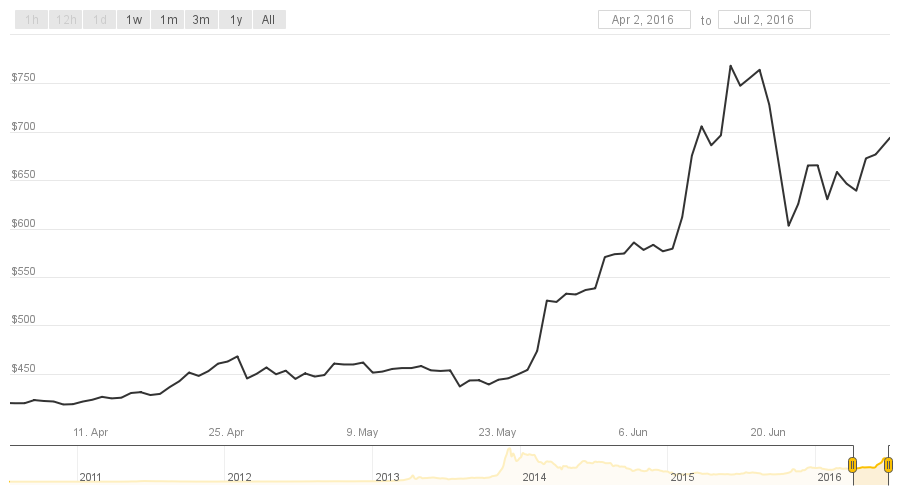
The greatest risks associated with bitcoin are the dramatic fluctuations in its price. BitThe price of a bitcoin rose by £163 ($220 USD) between 30 March and 29 June, 2016. Bitcoins were trading at £305 apiece on 30 March, 2016 and £468 on the morning of June 29. Coinbase reported that Bitcoin values reached a high of £566 on 19 June, 2016 – the day before the Brexit vote.coins trade on a market that can be dramatically disrupted by current events.
The price of a bitcoin rose by £163 ($220 USD) between 30 March and 29 June, 2016. Bitcoins were trading at £305 apiece on 30 March, 2016 and £468 on the morning of June 29. Coinbase reported that Bitcoin values reached a high of £566 on 19 June, 2016 – the day before the Brexit vote.
Coindesk bitcoin price index chart
What is a Bitcoin anyway
A bitcoin is an asset consisting of a chain of digital signatures; or addresses, stored in an open-sourced ledger called the blockchain. A high level of encryption and the use of unique characters theoretically make the bitcoin tamperproof.
Theoretically a bitcoin is supposed to contain a permanent record of value; so anybody can verify ownership, and the amount of assets stored. The purpose of the bitcoin is to transmit value through digital means. Other benefits; include anonymity, and secrecy from regulators, tax collectors and law enforcement.
Although many people view bitcoin as a currency, its legal status is a matter of opinion. Most regulators and legal authorities view bitcoin as an asset, while many users view it as a currency. Bitcoin’s legal status is in flux because has not yet been determined by courts or legislators.
Legal status of Bitcoin is uncertain
The currency’s legal status in the English-speaking world might be determined by a court case in the American state of Florida. A judge in the case is being asked to rule whether Bitcoin is a currency or personal property, American Bankerreported.
The case involves a man named Michel Espinoza, who attempted to use bitcoin for money laundering. Espinoza’s attorneys are arguing that bitcoin is not currency, so their client is innocent.
The Espinoza case might be appealed to higher courts, which could lead to a binding legal precedent on the status of bitcoin in the United States. That precedent might influence rulings in other countries such as the United Kingdom.
China’s parliament; the National People’s Congress, might set another important precedent for bitcoin with a law creating a legal definition for virtual property. The law would determine what rights Chinese have to use Bitcoin and how it is valued in the People’s Republic.
The Espinoza case and the Chinese law might resolve the biggest quandary bitcoin poses for insurers: how to classify the asset. The lack of a legal definition is probably the major reason why insurers; and underwriters, have steered clear of the product. A legal definition would enable the creation of binding policies.
Bitcoin and Insurance
There have been a number of attempts to analyse Bitcoin for insurance purposes. The UK-based company Elliptic provides risk analysis and intelligence, about illicit activities and other threats to blockchain based products.
Some security companies including BitGo specialise in bitcoin and blockchain. Security firm BitGo offers a secure digital wallet for bitcoin similar to PayPal and a number of other solutions.
At least one US company; Great American Insurance Group has written policies that cover bitcoin assets. Great American is a regional insurer based outside Kansas City, in the Midwest.
Other major insurers have researched bitcoin but not acted upon it. Lloyds issued an Emerging Risk Report on bitcoin in June 2015.
Risks to Bitcoin assets
The major risks associated with bitcoin assets are market losses and theft via hacking.
Market losses can be dramatic, between 20 June and 22 June, 2016; a bitcoin lost £119 of its value. The digital asset hit a high of £565 ($764 USD) on June 20 that fell to £446 ($603 USD) on 22 June, just two days later.
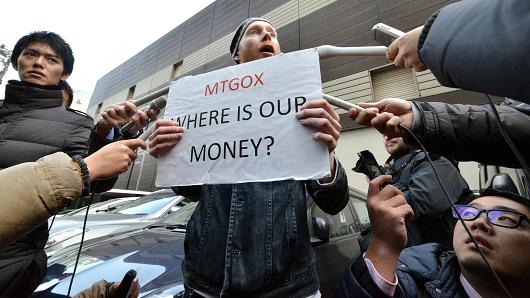
Bit coin trader protesting in front of Mt Gox office
The danger of theft via hacking was demonstrated in 2013, when 850,000 bitcoins worth an estimated £333 million ($450 million USD) were stolen from the Mt. Gox exchange in Tokyo by cyber crooks. Many of the coins were taken directly from the Mt. Gox hot wallet. Since Mt. Gox was used for 70% of global bitcoin transactions at the time, that theft represented a major loss.
Bitcoin is a popular target for thieves because of the high level of anonymity it provides. More recently it has been used in other criminal activities; including extortion schemes involving ransomware. Administrators at Hollywood Presbyterian Medical Center in Los Angeles paid extortionists 40 bitcoin worth $17,000 USD to remove ransomware from computers on 5 February 2016.
The main danger from bitcoin is as a disruptive force in the future because of the small amounts available. The total value of all bitcoins in circulation worldwide on 29 June, 2016 was estimated at £7.35 billion ($9.928 billion) by blockchain.info.
Despite that, bitcoin represents a technological revolution in money transfer; that all insurers will have to contend with sooner or later.
The insurance brokers PIB have launched a new telematics policy and fleet insurance product, almost immediately following their acquisition of Channel Insurance Brokers.
The new product will use telemetry data to develop a focused risk management solution that ultimately reduces costs for fleet operators.
This marks a significant achievement for PIB Insurance Brokers that will help them and their clients. The telemetry data gathered on a regular, monthly basis will be compiled into reports, which will then be given to fleet operators.
Along with the monthly reports will come personalised risk improvement advice, tailored to the performance of each business.
This new policy will primarily place evidence on vehicle telemetry and driver behaviour monitoring in order to create a three-year risk management programme by brokers and insurers.
The risk management data this new telematics product gathers will score drivers on their performance. It is designed to help fleet managers identify specific areas of improvement, based on evidence gathered.
By reaching performance targets companies will then be able to reduce risks, including the frequency, fluctuation and severity of motor-related insurance claims. Ultimately, by preventing accidents wherever possible it will reduce insurance premiums.
The product has already been made available to numerous UK companies in a wide variety of industries. Sports brands, coach operators, couriers and waste and haulage heavy goods vehicle operators have already adopted it.
It’s no wonder that the new product has taken off. This new telematics product has definitely handed more control back to clients. Through its use, they can benefit greatly. It allows PIB to work in-depth with fleet companies, ensuring their claims are managed proactively and costs are kept to a minimum.
It also creates a more sustainable insurance environment for businesses and brokers in the long term.
Towergate has formed a specialty underwriting division exclusively for the London Market.
John Murphy and Glenn Marshall, best known for their roles at international underwriting agency DUAL, have agreed to join the firm specifically to work in the new division.
Murphy and Marshall originally joined DUAL back in 2012 as senior underwriters. Murphy is a seasoned veteran in the London market who started his career at MW Payne Syndicate back in the 1970s. In turn, Marshall began his liability career at Lloyds back in 1986.
Adrian Brown, the CEO of Towergate Underwriting, remarked that the important hires were “indisputable evidence that we (Towergate) are attracting the very best talent in the market… to take a leading position in this space.”
After heading the special liability business at DUAL for the last three years, acquiring Murphy and Marshall is certainly significant. This also comes as Towergate has recently announced the hiring of another heavyweight in the industry, Martin Joyce. He will head Towergate’s regional specialty business based in Manchester.
Upon the hiring of Joyce, Brown commented that Towergate was “cracking on, seizing upon numerous opportunities to review and refresh our (their) broker proposition.”
This new venture by will write a general liability portfolio, including employer’s liability, public liability and product liability. It will be based on the new underwriting floor at Towergate’s Mitre Street office.
The new specialty underwriting division for the London market is all part of the strategy Towergate is implementing, which includes their nine point turnaround plan and two year integration project. The initiatives are designed to drive new business opportunities and strengthen the infrastructure of the organisation.
With these initiatives and the three high profile new hires, it’s obvious that Towergate are positioning themselves as leaders in their area. We will keep a close eye on any developments or future news with the underwriting expansion.


 Pokemon Go creates risks because it is an “augmented-reality” game which directs players to specific real-world locations using a phone’s GPS. At the locations the players are supposed to catch Pokemon characters. The risk is created when players get distracted by the game and stop paying attention to their surroundings.
A 15-year old girl in the American state of Pennsylvania was hit by a car on 13 July; after the game directed her to cross a busy highway, the Associated Press reported. The girl was taken to hospital with an injured collarbone and foot after being hit by a vehicle.
Two men fell off a seaside cliff near San Diego, California; while playing Pokemon Go on 13 July. Fire-fighters had to rescue the men after one fell 80 to 90 feet; and another fell 50 feet (15 meters), to the beach below. Both men were taken to hospital with unspecified injuries.
Pokemon Go creates risks because it is an “augmented-reality” game which directs players to specific real-world locations using a phone’s GPS. At the locations the players are supposed to catch Pokemon characters. The risk is created when players get distracted by the game and stop paying attention to their surroundings.
A 15-year old girl in the American state of Pennsylvania was hit by a car on 13 July; after the game directed her to cross a busy highway, the Associated Press reported. The girl was taken to hospital with an injured collarbone and foot after being hit by a vehicle.
Two men fell off a seaside cliff near San Diego, California; while playing Pokemon Go on 13 July. Fire-fighters had to rescue the men after one fell 80 to 90 feet; and another fell 50 feet (15 meters), to the beach below. Both men were taken to hospital with unspecified injuries.


 The chests of drawers did not meet US safety standards although they did meet European and Chinese safety standards. Even so, China has complained that they are being excluded from the recall program.
IKEA’s reputation is suffering from the publicity of 6 child deaths and their decision to not recall the same furniture in Europe and China because it meets safety standards in those regions. Such product accidents and recalls are only one example of how bad press can taint or destroy a brand’s reputation.
Often it does not matter what steps a company takes to address such issues such as a recall, the memory of such incidents can forever tarnish consumer trust in a brand.
The chests of drawers did not meet US safety standards although they did meet European and Chinese safety standards. Even so, China has complained that they are being excluded from the recall program.
IKEA’s reputation is suffering from the publicity of 6 child deaths and their decision to not recall the same furniture in Europe and China because it meets safety standards in those regions. Such product accidents and recalls are only one example of how bad press can taint or destroy a brand’s reputation.
Often it does not matter what steps a company takes to address such issues such as a recall, the memory of such incidents can forever tarnish consumer trust in a brand.
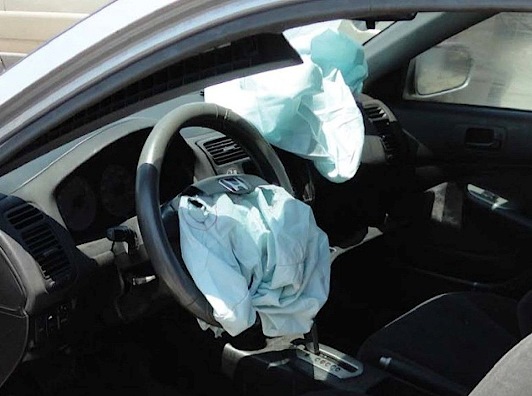 If one brand experiences a fault such as the airbag issue, consumers start worrying that all Japanese automakers are experiencing the same problem or share the same safety or quality faults. This makes trust dip and consequently sales.
Protecting a brand’s reputation is a key driver in today’s environment compelling companies to follow strict hiring, manufacturing and safety protocols as well as thoroughly vetting and dealing with respectable vendors. They do their best to ensure a high level of customer service, safety and satisfaction yet sometimes things go wrong.
If one brand experiences a fault such as the airbag issue, consumers start worrying that all Japanese automakers are experiencing the same problem or share the same safety or quality faults. This makes trust dip and consequently sales.
Protecting a brand’s reputation is a key driver in today’s environment compelling companies to follow strict hiring, manufacturing and safety protocols as well as thoroughly vetting and dealing with respectable vendors. They do their best to ensure a high level of customer service, safety and satisfaction yet sometimes things go wrong.