AIG introduces Brexit Insurance

0
AIG is betting that it can cash in on the political and legal uncertainty created by Brexit. American International Group has added Brexit coverage to its directors and officers, or D&O liability policies. The coverage will reimburse legal costs associated for European Union citizens who have their United Kingdom residency status revoked; if and when Brexit becomes official, Business Insurance reported. Another rider will cover legal costs for British subjects; whose permanent residency in an EU country is revoked after Brexit. If the legal challenge fails the coverage will cover “reasonable” relocation costs; including moving, school fees and travel fees. The Brexit coverage will be added to all D&O policies offered through AIG’s UK subsidiary at no extra charge. The company is trying to offer a free perk in an attempt to drum up more customers. Both new and existing policyholders will apparently be eligible for the Brexit insurance.

AIG is not taking that Big of Risk

Interestingly enough; AIG is not taking a very big risk with the Brexit insurance, because the details of Britain’s EU exit have not been worked out. It is entirely possible that a new treaty; that preserves the current status of EU citizens in the UK and British subjects in the Union, will be negotiated. Losing permanent residency because of Brexit is a purely hypothetical risk at the present time. That is why AIG is able to offer this coverage for free. If negotiations break down and it looks as if people might start losing permanent residency, AIG can start charging for the insurance at that time. The greatest risk for AIG with this coverage is that all permanent residencies might be revoked at some point. That might happen if negotiations collapse; or one side tries to use permanent residency as a bargaining tactic. The EU or UK might threaten to pull permanent residency status in order to force concessions out of the other side. That seems unlikely because of the political fallout which would result from such a move. Although EU citizens’ permanent residency is on the bargaining table, Prime Minister Theresa May has announced that “it will be part of the negotiation,The Financial Times reported. May has not said if she would use permanent residency as a bargaining chip. This means that any decision on permanent residency status is months or years away. The issue is further clouded by political opposition to Brexit in the UK and renewed calls for Scottish independence. The situation is complicated; because 62% of Scots voted against Brexit, while 52% of Britain’s population supported it. Scottish First Minister Nicola Sturgeon and her government are reviewing options for their nation, The Guardian reported. The options include independence and EU membership; or a new undefined relationship with the UK. Such uncertainty only increases the potential risks and the opportunity for new insurance products.

Global instability creates new opportunities for insurers

AIG has opened up a fascinating new market for insurance that might grow in coming years; instability insurance. There might be a growing demand for similar insurance products if global instability increases in the years ahead. Growing distrust in both national and international institutions; and increasing economic insecurity are fuelling a wave of global instability. Symptoms of this instability include the growing popularity of extremist politicians like the American Donald Trump, increasing terrorism and rising hostility to immigrants and international trade. Adding to the instability is the growing fear of potential military conflict between the United States and the People’s Republic of China. China and the USA are facing off in the South China Sea; because the Chinese are trying to build bases in the Spratly Islands, a territory claimed by the Philippines a key American ally. Fears of a conflict between Russia and NATO have also been increasing, because of Vladimir Putin’s moves against the Ukraine.
US navy conducts live firing drill in South China Sea
By Voice of America via Wikimedia Commons
Another catalyst of instability is falling oil prices; which are undermining some governments including those in Russia, Saudi Arabia and Venezuela. Each of those nations relies upon oil sales to finance government activities including social programs. Falling oil prices have already devastated Venezuela’s economy, and forced Saudi Arabia to slash government spending and increase taxes. Given this backdrop it is likely that we will see many more products like AIG’s Brexit coverage. The major markets for such instability insurance will be wealthy individuals and large corporations and their executives. Multinational companies like AIG; and the insurance syndicates at Lloyd’s of London, will be well placed to take advantage of this opportunity.

Fairfax acquires Zurich’s South Africa and Botswana insurance operations

0
Fairfax Financial Holdings recently announced that it has entered into an agreement with Zurich Insurance Company to acquire 100% of its South African and Botswana operations for an undisclosed amount. The announcement ended speculation that Zurich’s Swiss parent has been planning to exit South Africa. Zurich said in a statement: “At the group’s Investor Day in May 2015, Zurich stated that reshaping its geographic footprint would be one of its highest priorities over the next two years as it seeks to build a more sustainable business while also improving overall profitability.Zurich-South-Africa-Offices Zurich SA delisted from the Johannesburg Stock Exchange in September 2015 and became a wholly owned subsidiary of Zurich Insurance Group, which acquired the remaining 15% free-float it did not already own. “While South Africa and Botswana remain attractive markets, a comprehensive assessment found that there was limited scope for Zurich to achieve an operating scale that warranted continued investment,” the insurance group said. “The acquisition is the ideal outcome for our customers, our employees, the group and the insurance markets in South Africa and Botswana,” remarked Zurich SA CEO Edwyn O’Neill. “Selecting Fairfax as our acquirer allows us to continue to run the business with a strong local focus, while enjoying the backing and guidance of a global sector expert,” O’Neill added. The proposed acquisition of Zurich Insurance Company South Africa Limited (ZICSA) “represents an expansion of Fairfax’s commercial insurance presence in Africa and follows its purchase of a 7.15% stake in Africa Re in 2015,” Fairfax stated July 6 in a release. “Africa is a continent that represents a long-term growth opportunity for Fairfax, but where we have traditionally done little primary commercial insurance business. This acquisition represents a key step in expanding our presence in this important market,” said Prem Watsa, chairman and CEO of Fairfax. “It [Zurich Insurance Company South Africa] is a high-quality and well-known regional business, with an outstanding management team led by Edwyn O’Neill,” Watsa said, referring to both the SA and Botswana businesses. The 100% agreement is expected to close by the end of the year, pending various regulatory approvals. While the value of the deal has not yet been disclosed, the net asset value of the combined South African and Botswana business is estimated at some R1.8 billion (£97.3 million). Fairfax is a holding company which, through its subsidiaries, is engaged in property and casualty insurance and reinsurance and investment management. Fairfax also has holdings outside of the insurance industry, including retailers William Ashley China, Kitchen Stuff and Sporting Life. Other holdings include The Keg restaurant chain plus a majority voting interest in Cara Operations, owner of restaurants such as Swiss Chalet, Harvey’s, Milestones, Montana’s, Kelsey’s and East Side Mario’s.

Mounting student loans debt creating an economic risk

0
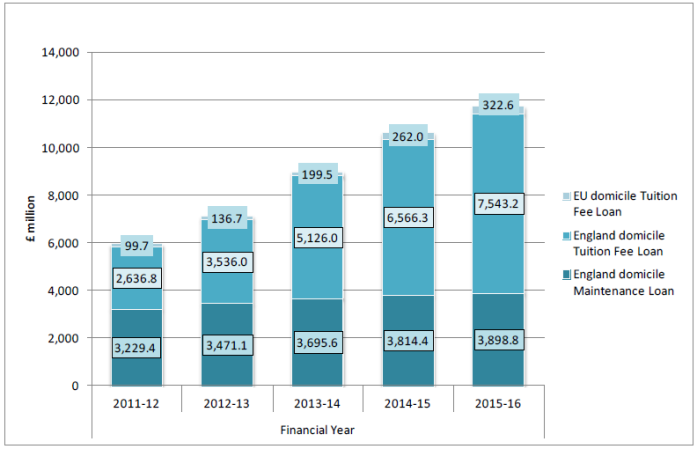
Each new student loan issued launches another person toward learning, self-discovery and a career. Unfortunately, each new loan also triggers what many observers warn is another tick of the student debt time bomb. Others liken swelling student loan debt to a bubble that could burst at any moment. Whatever the analogy, it’s easy to see why experts are concerned. As the United Kingdom has reduced its subsidies for tuition, student loan lending has nearly doubled over the past four years, jumping from about £6 billion in 2011-12 to £11.8 billion ($16 billion) in 2015-16, according to the Student Loans Company. That brought the total U.K. student loan balance up to £76.3 billion in 2015-16, an 18-percent increase from 2014-15.
SLC-Total amount lent in financial years 2011-12 to 2015-16
A growing number of students are not repaying their loans, a truth that threatens to leave the government high and dry. After 30 years, the loans are written off. Student loans debt has long been mounting but a big change in how the United Kingdom calculates interest, effective in 2013, has created much of the problem. Instead of paying just 1.5 per cent interest as they had been charged, student loan borrowers since autumn 2013 have been paying a rate equal to the Retail Prices Index plus 3 per cent – a total rate around 6.3 percent.
Only about 15 percent of students are likely to repay their loans from income alone
Under the current rates, because of compounding interest, only about 15 percent of students are likely to repay their loans from income alone, Tonbridge School researcher Dr Mike Clugston has told The Mail. That is considerably worse than the 40 percent of loans the government initially projected will be repaid, an alarming figure in itself. So, what’s the risk? Can students just keep piling up loan debt forever? For one thing, Millennials, or those aged 18 to 34, are having a harder time than previous generations buying homes, partly because of their student loan debt. Graduates in the UK must start making repayments when their incomes reach £21,000 which equal to 9 per cent of their income above £21,000. While most graduates will never fully pay back their loans, the 30 years of repayments they must make effectively constitute a tax. That millstone around their necks makes it harder for them to get on the housing ladder. Another reason to worry about the new trends in student lending is the effect they will have on government coffers. When the government decided to allow U.K. universities to triple their tuition from £3,000 per year to £9,000 per year, despite heated student protests, it projected the new system would cost less as long as at least 48.6 percent of loans are repaid. But as we’ve discussed, analysts say the government has been far too optimistic with its projections. As precarious as the situation might seem, the U.K. government is at less risk of students failing to pay back their loans than their counterparts across the pond. A major reason lies in how the two countries differ in their collection systems. U.K. borrowers typically have their repayments withdrawn directly from their payroll, while Americans usually make loan payments on their own.

Is InsurTech the future of Insurance

0
The technological revolution that has been disrupting finance is about to come to insurance with potentially dramatic results. A new generation of innovators is poised to apply Fintech solutions such as peer-to-peer transactions to insurance; in what might be called the InsurTech revolution. The most revolutionary concept is peer-to-peer insurance; which utilizes the techniques of peer to peer lending. A peer-to-peer lender like Lending Club does not underwrite loans; instead it puts the loans on a platform. Investors review the loans and underwrite them as an investment. A German company called Friendsurance has created a platform which allows policyholders to insure each other through small pools. The members of each pool underwrite each other’s policies with their premiums. If a claim exceeds the pooled funds, reinsurance makes up the difference. The big advantage to this is that it allows private individuals to take advantage of the reinsurance market. The pools can tap the syndicates operated through companies; like Lloyds of London, for reinsurance in the same way that big business traditionally has. One way this would work is to allow customized insurance for people with a similar level of risk, such as the young or persons that work in a particular field such as medicine. That makes it easier to reinsure the pools through the market. Friendsurance aims to attract customers by paying cashback at the end of the year. if no claims are paid. The idea behind that strategy; which is used by some American insurers like Allstate, is to attract low-risk customers by rewarding them. Friendsurance’s business model seems to be limited because only a few kinds of coverage are offered through its platform. Currently only home contents (homeowner’s or renters’ insurance in the United States), private liability and legal expenses policies are offered. The company seems to be avoiding some of the more complex areas of insurance; such as auto and business coverage, which indicates the limitations of its technology.

Behaviour based Insurance

A company that aims to overcome those limitations is the American start up Lemonade. Lemonade hopes to mitigate the inherent risks of peer to peer insurance with a behaviour-based business model. The company has hired Dan Ariely; a professor of psychology and behavioural economics at Duke University, as its “Chief Behavioural Officer,” The Insurance Journal reported. Ariely’s job is to devise methodology that will identify dishonesty, fraud and other behaviours that increase risks. Ariely thinks insurance can be reengineered to reward less-risky behaviour. The idea is hardly a new one, many insurers offer lower rates to customers that take fewer risks. Lemonade’s president; Shai Wininger, wants to take that concept to the next level by creating insurance policies that reward good behaviour. Wininger did not say how this would be accomplished but hinted that Lemonade has proprietary InsurTech designed to achieve that goal. The technology might be rooted in Ariely’s belief that irrationality is predictable. Dishonesty is a major threat in peer-to-peer insurance because policyholders might lie to cover up risky behaviour. Wininger and Ariely seem to believe they have technology; perhaps a computer algorithm, that can identify signs of risky behaviour and write policies accordingly. The technology must be impressive because Lemonade has raised $13 million (€9.91 million) from investors, Insurance Journal reported. The company has lined up some respectable reinsurance partners; including Warren Buffett’s Berkshire Hathaway and some Lloyds of London syndicates. Lemonade has also attracted some experienced leadership. Its current management team includes Ty Sagalow; a 25-year veteran of AIG, as Chief Insurance Officer. Fellow AIG executive Ron Topping and Robert Giurlando and James Hageman from ACE Insurance have joined the company in undisclosed roles. It is not clear if Lemonade technology works yet because its website is currently under construction. News articles did not indicate if Lemonade has tested its solutions, or when its policies might be rolled out.

Google Abandoned InsurTech

The inherent limitations of InsurTech were demonstrated in March when Alphabet, pulled out of the field. The search engine giant shut down its insurance marketplace; Google Compare on March 23, Market Mad House reported. The solution allowed shoppers to compare policies, credit cards and mortgages. Alphabet pulled the plug on Google Compare because it was not making any money off the policies it was selling. The marketplace was unprofitable; because Google was unable to navigate the complex web of insurance regulations that exists in the United States. In America; each of the 50 states, has its own set of rules for insurance. Some states mandate completely different models of common types of coverage such as auto insurance. That makes it difficult to write basic policies that can be easily offered through an online marketplace. Alphabet also shut down Google Compare in the United Kingdom, possibly because the business model did not work in larger markets like the United States or the European Union. Another problem Alphabet was apparently unable to overcome was the inability to identify risk factors online. The technologists behind Lemonade think they have overcome that deficiency even though they offer no proof of their claims. A major problem that Lemonade faces is convincing regulators to approve its products. That will be tough because some American states such as Michigan mandate so-called no-fault auto insurance; in which risk is shared by all drivers. Under that system, Lemonade’s behaviour-based business model might be illegal.

InsurTech revolution might be years away

The inability of such a well-financed and technologically adept company as Alphabet to operate profitability in InsurTech shows how limited present solutions are. It will take a completely different business model and years of trial and error to get peer-to-peer insurance to work. Despite all the money and resources being invested in InsurTech; a workable peer-to-peer insurance platform is probably a decade away. Large scale disruption of the insurance market by InsurTech is not possible, without major improvements in the technology. A true InsurTech revolution will take major investment; a strong commitment by large insurers, and new technological solutions. All of those developments are just beginning, meaning InsurTech is not yet a threat to the traditional insurance industry.

Allianz, Nephila announced successful pilot on blockchain catastrophe risk trading

0
Insurance giant subsidiary, Allianz Risk Transfer AG (ART) and Nephila Capital, the world’s largest reinsurance risk investors, reportedly have managed to use blockchain-based smart contracts to conduct a natural catastrophe swap in a pilot test, indicating that processing and settlement can be significantly fast-tracked and simplified between insurers using blockchain technology. Catastrophe swaps or “cat swaps” and bonds transfer a specific set of risks, including natural disaster risks like hurricanes or typhoons, from one insurer to other insurers or investors. These are instruments traded in the market which allow insurers to avoid potential losses. In a cat swap, the insurer pays a third party to assume the financial risk of a defined major natural disaster in exchange of a payment or series of payments. In a statement released by Allianz, automating the time process for payment transactions between insurers and investors can now be reduced to as low as a few hours from weeks or months after a disaster, thanks to smart contract based on blockchain technology. Allianz and Nephila further announced that the successful test run demonstrated transaction processing and settlement between insurers and investors can be “significantly accelerated and simplified” by blockchain-based smart contracts. The test also pointed to other benefits including better tradability of cat bonds and also opened up opportunities to apply the technology in other insurance transactions. Richard Boyd, Allianz Risk Transfer Chief Underwriter, commented: “Blockchain technology would increase reliability, auditability and speed for both cat swaps and bonds as less manual processing, authentication and verification through intermediaries is required to confirm the legitimacy of payments/transactions to and from the investors.” “By replacing the human interventions which are currently embedded throughout the entire risk transfer process, frictional delays and the risks of human error are completely removed – with a radical effect on the speed and efficiency of the process and, in the case of bonds, on the tradability of such securities,” he added. Allianz Risk Transfer and Nephila have worked with various firms to develop the proof of concept and extensions of this technology. These companies see blockchain technology having relevance across the insurance trade. Optimizing payment process used in international fronting for captive insurers, in which numerous stages are required for transferring premiums from a corporation to its own subsidiary, is one example. In recent months, large insurance firms have taken interest and started to investigate blockchain technology and its opportunities to improve services. The successful pilot test made by Allianz and Nephila is just the latest of these activities. One of the largest accounting firms, PwC, announced earlier that they will support the research of the application of blockchain technologies in the area of insurance. Insurance provider John Hancock also declared collaboration with ConsenSys Enterprise on proofs-of-concept using blockchain and BlockApps.

EIOPA advises to enhance the asset class under Solvency II

0
In a report published by The European Insurance and Occupational Pensions Authority or EIOPA, published a report to advise on the extension of the infrastructure asset class for high-quality investments under Solvency II. The report covers the Technical Advice to the European Commission (EC) on the identification and calibration of infrastructure corporates.
EIOPA's flag flapping in front of Westhafen Tower
EIOPA’s flag flapping in front of Westhafen Tower
The said advice was established upon request from the EC to further elaborate on the Advice of 29th September 2015 where EIOPA proposed a new asset class under Solvency II for investments in infrastructure projects. In its latest advice, EIOPA recommends to extend this asset class in two ways. The first one is to let certain infrastructure corporates to qualify for the management for infrastructure projects only if there is an equivalent level of risk. The second is to generate a separate differentiated management for equity investments in high-quality infrastructure corporates. EIOPA proposes to reduce the risk charges for equity investments if the corporates have a lower risk profile. Insurers are required to conduct adequate due diligence and create written procedures in order to monitor the performance of their exposures and EIOPA also recommends that they perform stress testing on the cash flows and collateral values supporting their investment Gabriel Bernardino, Chairman of EIOPA, said in a statement: “After having carefully analysed the evidence available, we propose a risk-based enhancement of the Solvency II asset class for high-quality infrastructure investments regarding infrastructure corporates. As infrastructure investments can be complex, they require prudentially sound treatment and specific risk management expertise. Where the risks are probably managed, our proposals will help insurers to match their long-term liabilities, to increase their portfolio diversification, and thereby better protect policy holders and support the strategic objective of building the EU Capital Markets Union”. EIOPA’s Financial Stability Report consists of two parts – the standard part and the thematic article section. The standard part is structured as in previous versions of the EIOPA Financial Stability Report. The first chapter discusses they key risks identified for insurance and occupational pension sectors. The second, third and fourth chapter provides the final qualitative and quantitative assessment of the risks identified. This assessment is done in terms of the scope as well as the probability of their materialization using economic techniques and qualitative questionnaires. Finally, the thematic article elaborates on the impact of mergers and acquisitions on European insurers using data on equity prices.

Lloyd’s represented in Latin American Market with new Colombian office

0
Advent and Brit, two Lloyd’s insurers, have been represented on the Lloyd’s Colombia Platform, alongside the Lloyd’s representative office. Led by the first Colombian General Representative for Lloyd’s, Juan Carlos Realphe, the new office was created to focus on developing trade relationships in the Latin America market, which is expanding quickly. The Chairman of Lloyd’s, John Nelson, called Colombia “An important part of Lloyd’s future growth strategy, both as a fast-growth market and as a gateway to Latin America.” He was reportedly delighted to be expanding into the Latin American market through Colombia, “a growing economy which is making significant investments for the future.” Beneficial for Lloyd’s growth into this emerging market is the fact that insurance penetration there is one of the lowest in the region, at just 1.6% GDP. Furthermore, according to Nelson, “as Colombia realises its economic potential, insurance and reinsurance can play a key role in supporting this economic growth by improving resilience, taking risks out of the country, and helping the economy recover after catastrophes.” While in Colombia to open the new office, Nelson met with Colombia President Santos and the country’s Minister of Finance, Mauricio Cárdenas. In the meeting held at the Presidential Palace in Bogota, they spoke about Colombia’s economic and political transformation in the past decade, and how insurance can play a vital role in supporting and protecting the country’s long-term business and economic growth. Finally, Lloyd’s held a launch event attended by insurance professionals in the country, where Nelson highlighted the Colombian Government’s “4G” infrastructure project. Through it, 8,000 kilometres of roadway and 3,500 kilometres of four-lane highway will be developed throughout the country This project will serve to boost the Colombian economy and drive increased growth for the future. With the nation’s government keen to increase Colombia’s competitiveness in Latin America, there is, as Nelson stated at the event, “a real sense of global confidence in Colombia’s future.” Initiatives such as the 4G project and Lloyd’s entering the Colombian market will help protect their economic growth and further support Colombian businesses as they work to expand into new markets themselves. In the words of Nelson, “by leveraging our world-class brand; by bringing our underwriting expertise, innovation and financial strength to help attract new business into the Colombian economy – we think we can add real value that will benefit the country as a whole.

US Justice Department moves to block health insurer deals

0
By Caroline Humer and Carl O’Donnell NEW YORK (Reuters) – U.S. antitrust officials on Thursday moved to block an unprecedented consolidation of the national health insurance market, filing a lawsuit against Anthem Inc.‘s proposed purchase of Cigna Corp and Aetna Inc.’s planned acquisition of Humana Inc. The U.S. Department of Justice said the two multibillion-dollar mergers would reduce competition, raise prices for consumers and stifle innovation if the number of large, national insurers were to fall from five to three. It was the latest example of the Obama administration challenging massive combinations in major industries, from oilfield services to telecommunications. “We will not hesitate to intervene. We will not shy away from complex cases,” U.S. Attorney General Loretta Lynch told a news conference on Thursday. “We will protect the interests of the American people.” The deals would hurt consumers in the different markets served by the four companies, from medical coverage provided by large corporations to their employees to Medicare Advantage plans for the elderly and insurance sold to individuals on exchanges created under President Barack Obama’s healthcare reform law, the Justice Department said. “We have no doubt that these mergers would reduce competition from what it is today,” said Principal Deputy Associate Attorney General William Baer, who spearheaded the antitrust reviews. Merging Aetna’s and Humana’s Medicare Advantage businesses would create the largest U.S. manager of the healthcare insurance for seniors and the disabled. The Anthem deal for Cigna would create the largest U.S. health insurer by membership, with about 53 million members, surpassing UnitedHealth Group’s 45.9 million as of June 30, and make it the leader in employer-based health insurance. Aetna and Anthem had each argued their proposed purchases would help lower prices for consumers by giving them greater leverage in negotiating with doctors and hospitals.

Aetna vows legal fight

Aetna and Humana said Thursday they plan “to vigorously defend the companies’ pending merger,” worth $33 billion (£25 billion). Aetna Chief Executive Mark Bertolini said the company has proposed divesting enough assets to ensure competition in markets where it overlaps with Humana. “If we can’t come to a negotiation on what markets to divest, although we have two very complete remedies in front of the Department of Justice now, I think I’m willing to let a judge decide,” Bertolini told business news channel CNBC. “We’ll go all the way we need to to make this happen.” Anthem had a more muted response, saying it was committed to working toward a settlement with the Justice Department for its $45 billion transaction, but would challenge the lawsuit if necessary. Cigna said it was evaluating its options. It does not believe a deal would close before 2017, “if at all.” After news of the lawsuit, Humana raised its 2016 earnings forecast, saying its core businesses, Medicare Advantage and Healthcare Services, are performing better than expected. Humana shares rose 8.3 percent. Cigna climbed 5.4 percent, Anthem closed up 2.6 percent and Aetna rose 1.6 percent. Speculation that the U.S. government would block both deals had weighed on shares of all four insurers for several weeks. Humana’s raised forecast “bodes well for the rest of the industry. Now you can expect the other guys to report good numbers and perhaps raise guidance as well,” said Jeff Jonas, portfolio manager for Gabelli Funds, which holds Cigna and Humana shares. “There’s somewhat of a relief rally, too, given that this has been an overhang for so long, particularly with Anthem and Cigna,” he said.

Concern for different consumers

In the lawsuit against Aetna, the Justice Department cited specific concerns about damage to 1.6 million people in 364 counties who are customers of Medicare Advantage, the program that serves older people. It also said there were issues for the individual plans sold on Obamacare exchanges, where the government has sought to spur competition and keep prices low. About 20 state insurance departments were required to review the Aetna-Humana deal. Missouri came out firmly against it, while others, including California and New York, approved it after reaching a settlement. In the lawsuit against Anthem-Cigna, antitrust regulators said the combination would substantially lessen competition in an already consolidated industry, harming millions of Americans, doctors and hospitals. The Justice Department said it was concerned about the impact on the national corporate business, which serves large companies and which it said has only four competitors. It also said there were issues with local business markets, the individual Obamacare exchanges and the impact a combined company could have on contracts with doctors. The presidential campaign of Democrat Hillary Clinton, who said when the deals were announced she was “very sceptical” they would benefit consumers, said Thursday they “applaud” the Justice Department’s decision. “Hillary will continue to fight to reduce health costs and strengthen antitrust enforcement to prevent corporations from gaining too much market power,” Clinton policy adviser Ann O’Leary said in a statement. Doctors and hospitals had urged the Justice Department to try to block the deal, and some large employers were also against the combination. Aetna and Anthem had each proposed asset sales to the regulators, but they did not adequately address the loss of market competition, Baer said. Eleven states and the District of Colombia joined the Justice Department lawsuit against Anthem and Cigna; eight states and DC joined the lawsuit against Aetna and Humana. If the government successfully scuttles the deals, Anthem would owe Cigna $1.85 billion in breakup fees. Aetna would have to pay Humana $1 billion. If the deals fail for other reasons, the breakup fees would be different. The unusual move against two deals in the same industry represents a repeat of history for Baer, who headed the department’s Antitrust Division until a short time ago and is now the No. 3 official in the Justice Department. In March 1998, Baer asked a court to stop a major consolidation of the U.S. drug wholesaling business. McKesson Corp had sought to buy AmeriSource Health Corp, and Cardinal Health wanted to buy Bergen Brunswig Corp. A court granted the preliminary injunction. (Reporting by Caroline Humer and Diane Bartz in Washington DC, additional reporting by Jon Stempel, Lewis Krauskopf and Carl O’Donnell and Bill Berktot in New York; Editing by Michele Gershberg, Nick Zieminski and Bernard Orr)


Broker Arthur J. Gallagher expands in Scandinavia with Brim’s acquisition

0
US-based insurance brokerage and risk management services company Arthur J. Gallagher & Co. (AJG) has further cemented its presence in Scandinavia through the acquisition of 85 percent majority share in Brim AB. Through this buyout, AJG taps into a first-class client base of about 2,000 diverse customers. The acquisition is also a boost to AJG’s successful purchase of Norway-based marine, energy and specialty insurance broker Bergvall Marine in December 2013. As part of the deal, CEO ikard Öijermark and partner Fredrik Enderlein will continue Brim’s operation under the ultimate headship of Grahame Chilton, head of AJG’s international brokerage operations in London. Established in 2001, Brim is a specialty insurance and reinsurance broker that offers two core practices. Its credit and political practice provides financing support for key infrastructure projects worldwide, while the construction practice supports commercial and residential building development, as well as infrastructure and civil engineering across Finland, Norway and Sweden. The Sweden-based company now employs 19 people and generates approximately 11 million revenues per year. In 2013, Brim snagged the prestigious Insurance Award from Risk & Försäkring, a unit of Svenska Nyhetsbrev, a top supplier of independent business, financial and industrial news in Sweden. That same year, it opened an office in Dubai as part of its customers’ international expansion. Arthur J. Gallagher and Brim have been global alliance partners over the years; AJG’s London office has assisted Brim on its projects with Lloyd’s of London. “Brim’s operations are highly regarded and well respected in the International insurance market. For many years, we have had a successful correspondent trading relationship with Brim, during which time we developed strong working relationships with their team,” said J. Patrick Gallagher, Jr., Chairman, President and CEO of AJG. “Taking this next step allows us to partner with an outstanding group that has extensive experience in their particular markets, adds their expertise to the long list of capabilities we will be able to offer our international customers, and broadens our Scandinavian presence. We are extremely pleased to welcome Rikard, Freddy and their colleagues to our growing Gallagher family of professionals.” Rikard Öijermark, CEO of Brim, commented: “We have enjoyed great success working with Gallagher’s London Specialty, International and Reinsurance teams and built a strong rapport with the organisation and its leadership. Being part of the Gallagher group will open up new avenues of growth for us globally, along with access to a whole new range of products, services and capabilities to offer to our clients. We see a great and exciting future ahead of us and look forward to becoming part of the Gallagher team.” Brim’s acquisition is AJG’s first purchase in the third quarter of 2016. In the previous quarter, it completed 10 buyouts as part of its strategic international expansion. Aside from expanding the company’s geographical reach, these acquisitions also support its portfolio of services and reinforce its position in risk management industries and retail and wholesale insurance brokerage services.

Memorandum of Understanding signed between Europe and China

The European Insurance and Occupational Pensions Authority (EIOPA) and the China Insurance Regulatory Commission (CIRC) have recently met in Budapest to sign a Memorandum of Understanding. Through it, both authorities agree to participate in an Executive Committee meeting of the International Association of Insurance Supervisors (IAIS). The Memorandum forms the basis for cooperation between the two regulatory bodies, in order to achieve three objectives:
  • Building a practical framework for exchanging supervisory information
  • Updating one another on regulatory and supervisory framework developments for both insurance and private pensions
  • Increasing mutual understanding of the Chinese and European supervisory regimes for insurance
By signing this Memorandum, both the EIOPA and CIRC have agreed to set up joint annual work programmes and expert task forces, as well as provide speakers for events organised by both authorities. They will also pursue other joint activities. The two authorities have also pointed out that signing the Memorandum does not include a legal obligation to exchange confidential information, nor does it create any legal obligations between the parties involved or the European Union. Chairman of the CIRC Xiang Junbo stated, “The China Insurance Regulatory Commission and the European Insurance and Occupational Pensions Authority have always enjoyed a close relationship. The signing of this Memorandum of Understanding is a declaration of the two sides’ common vision to further our mutual communication and supervisory cooperation.” Under the framework of the Memorandum, the two parties believe that more could be done to facilitate the exchange of information and experiences between the European and Chinese authorities. For his part, Gabriel Bernardino, the Chairman of EIOPA, pointed out that, “the constant process of deepening ties between Europe and Asia and increasing cooperation is crucial for effective supervision and adequate protection of consumers.” By signing the Memorandum of Understanding, he hopes to take an important step to further develop the relationship between both the Chinese and European insurance authorities, thus ensuring “improved supervisory convergence” worldwide in time.